
My email statement on the first anniversary of the Singapore Summit was partially included in Radio Free Asia Korean Service’s two stories of June 5 and June 10 on the original Trump-Kim summit. Here are the links in Korean (use Google Translate to get the gist of the full articles):
https://www.rfa.org/korean/in_focus/news_indepth/newsindepth-06042019141847.html
https://www.rfa.org/korean/in_focus/news_indepth/newsindepth-06102019140738.html
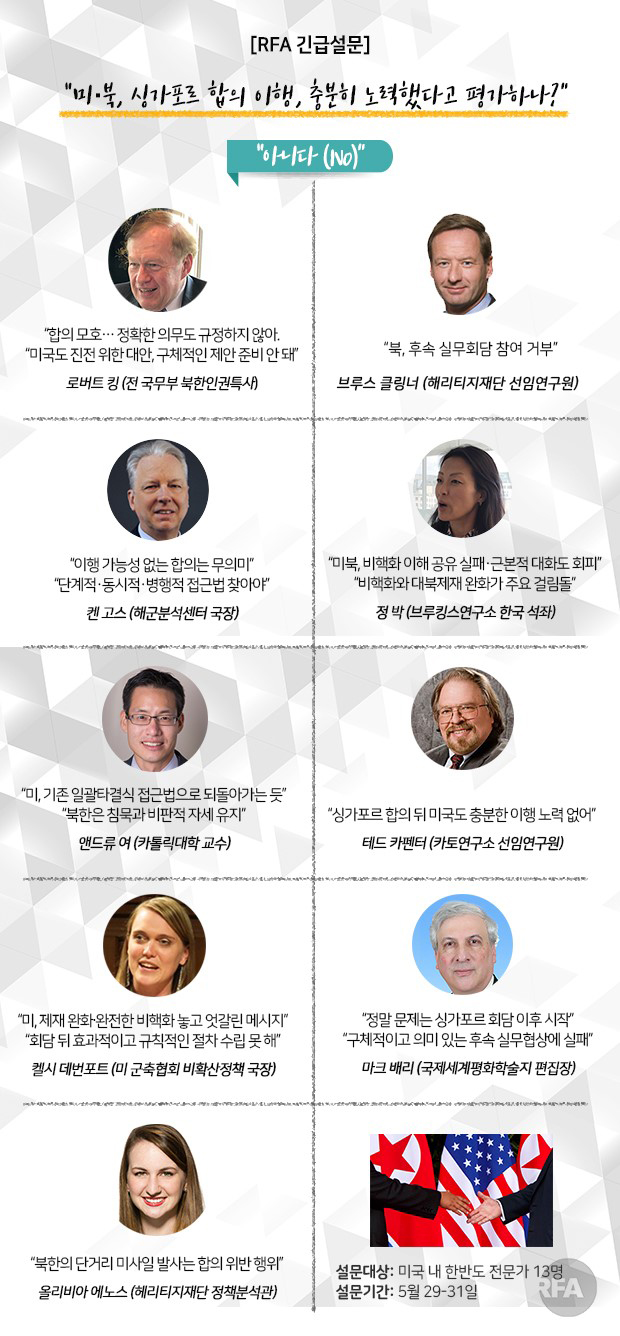
And, courtesy of RFA, here is the full English-language text of all 13 experts’ submissions, myself included:
Robert King
The Singapore Summit was a first step in an effort to improve the relationship between the DPRK and the United States. It was more a hopeful promise for the future than a fundamental change in policies or attitudes right now. In that regard the follow-on Hanoi Summit in April underlined the fact that the Washington and Pyongyang still have a long, long way to go. The difficulty of resuming discussions at levels below that of Kim Jong-un and Donald Trump only highlights that the relationship has not fundamentally changed. American efforts at lower levels to engage with the North before the Hanoi Summit were largely unsuccessful, and efforts since Hanoi to lay out a path forward have been rebuffed by the North.
“No” is not the final answer, but if there is no change by the North in its willingness to reengage with the U.S. and if there is no willingness by both Kim and Trump to empower diplomats to work out the details of a way forward, “No” will be the final answer.
The Summit declaration was vague, and no precise obligations were made. Over the last year, the U.S. and the DPRK have little or nothing to “build a lasting and stable peace regime on the Korean Peninsula” or to “work toward complete denuclearization of the Korean Peninsula” as points 2 and 3 of the joint statement pledged. At Hanoi, Kim Jong-un was intransigent in his offer to make only limited concessions on denuclearization. He was willing to close the Yongbyon nuclear facility, but no other nuclear facilities, in return for the U.S. working to life all UN economic sanctions against the North. President Trump was unprepared with alternatives or concrete proposals on ways to move forward.
The only somewhat positive exception to the meager efforts and skimpy results is the commitment made in point 4 of the Singapore statement. Both countries committed to recovering POW/MIA remains from the Korean War era, an important issue for Washington. In the summer of 2018 just a month or so after Singapore, 55 sets of American military remains from the Korean War era were handed over to U.S. military officials. That was almost a full year ago, but there has been no success in continuing engagement with the North by U.S. officials to recover additional remains. Earlier this month The U.S. Department of Defense announced that no further progress has been made with the North on this issue, and the remains recovery effort is being suspended.
It is unlikely that a third summit will take place this year. Kim appears to be facing internal turmoil, based on recent news stories that he ordered the execution of his most senior aide/advisor on dealing with the United States and the execution or imprisonment of other senior officials. President Trump is facing his own internal issues with renewed calls for his impeachment and the intensification of his political campaign for reelection.
Most important, however, both leaders are anxious to have success if they meet again because failure would be costly to both their images, particularly after the humiliating failure at Hanoi. The remainder of this year is not enough time for both sides to make their own internal decisions about what concessions each can make for a successful meeting. Both sides will need to be better prepared at the staff level. Those decisions and the preliminary negotiations will take more than the next seven months. Kim is also unlikely to push for a quick follow-up meeting in light of the upcoming U.S. election. He will not want to make an agreement with a lame-duck American president, and until the outcome of the next U.S. election is clearer, Kim is likely to move slowly.
Gary Samore
It is far too early to say whether the Singapore Summit is a success or failure because denuclearization will take many years to complete if at all. Singapore achieved an important first step — the freeze for freeze — but the Hanoi Summit failed to produce additional measures. A Third Summit is possible before the US Presidential elections only if both sides compromise the unrealistic proposals both side made in Hanoi.
Jung Park
Singapore was not a success. It was hastily arranged, produced little but frothy statements about denuclearization, let the air out of maximum pressure, and gave Kim Jong Un the international status of meeting the U.S. president without imposing costs for his nuclear weapons program and aggressive behavior.
The US and North Korea did not have a common understanding of “denuclearization” and the two sides avoided talking about the fundamentals of what a nuclear deal might look like. Instead, North Korea’s actions at Punggye-ri nuclear test side and the Sohae missile facility were reversible, cosmetic gestures that created the illusion of North Korea’s compliance with the Singapore summit. On nonnuclear issues, the two sides kept up to some degree — for example, the return of some POW/MIA remains from North Korea, and in Hanoi, there was reportedly broad agreement on a peace declaration and liaison offices, but the nuclear issue and the lifting of sanctions were the main sticking points.
A third summit seems unlikely before the end of 2019 under current circumstances. The Trump administration is not budging on sanctions and Kim Jong Un has publicly stated that the onus is on Washington to change its approach to North Korea. Moreover, North Korean has been rebuffing efforts at working level discussions with both the United States and South Korea.
Bruce Klingner
The Singapore Summit was not a success. That meeting produced a weak, poorly crafted summit statement that had weaker denuclearization commitments that previous agreements and unwisely accepted that North Korean paradigm that denuclearization is just one of four equally important issues. Previous U.S. administrations had insisted on the centrality of denuclearization.
The Singapore summit initially created a false sense of accomplishment with Trump falsely claiming that the North Korean nuclear problem had been solved. He compounded this error by unilaterally cancelling allied military exercises without gaining anything in return from Pyongyang which continued its own military exercises unabated.
The subsequent Hanoi Summit showed that Kim Jong-un was no more willing to fully denuclearize than his father and grandfather were. He offered the same “Yongbyon only” agreement as his predecessors.
During the subsequent six months after the Singapore Summit, North Korea refused to participate in working level meetings that Kim Jong-un had agreed to. When envoy level meetings did convene, the North Korean representative was authorized to speak of every topic except denuclearization. Since the Hanoi Summit, North Korea again refuses to participate in diplomatic meetings with the United States or South Korea.
The U.S. has stated that a third summit is dependent on North Korea participating in working level meetings that result in progress toward creating a viable denuclearization agreement, Until Pyongyang agrees to resume diplomatic engagement, a third summit seems remote.
However, in December 2018, National Security Advisor John Bolton stated that it was the very lack of progress which affirmed in President Trump’s mind the necessity of a second summit. Therefore, a third summit is possible either to overcome any lack of progress or to defuse tensions caused by future North Korean provocative behavior.
Andrew Yeo
Singapore cannot be seen as a success since we are not any closer to denuclearization or a new framework for finding peace on the Korean Peninsula since the summit. That’s not to say there weren’t any positive effects. Steps towards the summit helped deescalate a tense situation, and a meeting between the two heads of state was symbolically significant. But substantively, we can’t evaluate Singapore as a success.
Negotiations leading up to Hanoi seemed to be moving in the direction of a phased or stepwise approach which was more in the spirit of the Singapore summit. But the Hanoi meeting seemed to revert back to the previous US approach of striking a big deal, and the North Koreans since Hanoi have either remained mostly silent and critical, even conducting short range missile tests.
Not likely, but hard to rule out with Trump. Trump has been saying nice things about Kim so he may still hope for another meeting. But I think this time around, the stage will need to be set first at the working level before getting the leaders to meet again.
Ted Galen Carpenter
Yes, the Singapore Summit should still be considered at least a partial success. It opened a crucial dialogue between the two countries at the highest level. That breakthrough was an essential prerequisite for meaningful progress on any of the longstanding bilateral disputes.
No, not enough effort has been made to follow up on the initial successes, especially on the U.S. side. Bolton and Pompeo have been especially unhelpful. Indeed, they seem determined to sabotage the embryonic detente between the two countries.
There is less than an even chance of a third summit before the end of the year. It is more likely to occur during the summer of 2020. President Trump would like to display a major foreign policy achievement going into the November 2020 election. Considerable preparation will be needed, though, and both sides will have to limit their goals. North Korea will not take steps to abandon its entire nuclear program, nor will the United States agree to lift all sanctions. More limited steps, though, are achievable. So too is a peace treaty ending the Korean War and establishing diplomatic relations. Such a settlement would be a huge achievement and greatly reduce tensions on the Korean Peninsula.
Scott Seaman
No. While there has been some progress in efforts to return the remains of US soldiers killed during the Korean War, there hasn’t been much progress at all in completing the other tasks the two sides agreed to tackle in the Joint Statement. Kim stopped long-range missile testing and underground nuclear tests before the Singapore summit, so while that pledge appears to be holding for the time being, it was not a pledge that Kim made at the summit.
It’s much easier to argue that the summit has been a success for Kim as it opened a pathway for him to engage in an intense effort to improve his and North Korea’s international image, transform North Korea into a “normal” country, and make new and stronger diplomatic and political connections with the outside world, despite the sanctions regime that makes economic and trade interactions very difficult.
Less than 10% probability of a third summit this year. The two sides show no signs of softening their negotiating positions anytime soon, and Kim’s regime has been ramping up its provocative rhetoric and actions, making it more difficult for President Trump to want to appear as if he’s being more flexible because of North Korea’s threats.
The number one precondition for a third summit is a decision by Trump that meeting with Kim again will improve his chances of winning reelection in November 2020. For Trump, nothing else matters.
Olivia Enos
The Singapore summit was primarily pomp and circumstance and delivered little of substance. Unlike the Hanoi summit which fell apart at the scene, the Singapore summit unraveled slowly after giving a temporary mirage of success.
Singapore failed to deliver irreversible commitments by North Korea to denuclearize, made no mention of human rights challenges in the country, and sacrificed U.S. and South Korean preparedness for conflict on the Korean peninsula after President Trump temporarily suspended and eventually cancelled joint military exercises. While there was much hope that Singapore would deliver results, it has, thus far, failed to do so.
North Korea’s recent missile tests violate the spirit and letter of commitments made in Singapore (and international law). North Korea is no closer to denuclearizing than it was prior to Singapore and human rights conditions in North Korea continue to deteriorate.
Secretary Pompeo expressed an interest in holding a 3rd summit shortly after the Hanoi summit and President Trump indicated after Hanoi that the door was open for continued diplomacy. Given the rapid pace of how both Singapore and Hanoi came together, it is entirely possible that another summit might take place in 2019. However, I think this would be highly unwise given how little diplomatic efforts have delivered thus far.
There need to be robust working level negotiations where the two parties have agreed to a set of action-items that are tangible and verifiable. Such commitments should focus not only on denuclearization, but also on improving human rights challenges inside the country. Without a more comprehensive approach toward North Korea — one that acknowledges the importance of addressing human rights challenges — it will likely be difficult to deliver on denuclearization.
Kelsey Davenport
It is too soon to declare the Singapore summit a success. The decision to engage in diplomacy pulled Trump and Kim out of the escalatory spiral of provocative actions and rhetoric that increased the risk of conflict in 2017, but to date, the diplomatic process initiated in Singapore has failed to make concrete progress toward its twin goals of denuclearization and peacebuilding on the Korean peninsula. Despite the lack of progress, it is also too soon to characterize the summit as a failure. Negotiations are the only option for reducing the threat posed by North Korea’s nuclear weapons program. Trump and Kim both appear willing to continue talks, so the window of opportunity created by Singapore summit remains open and could result in actions that roll back North Korea’s nuclear weapons program and stabilize the region.
There have not been sufficient efforts to realize the goals of the Singapore summit declaration. Since Singapore, the Trump administration has sent mixed messages about the scope of the talks and failed to establish an effective and regular process for engaging with North Korea’s negotiating team. Trump has also pursued an inflexible and maximalist approach to denuclearization that front loads action by Pyongyang to dismantle its nuclear weapons program prior to any sanctions relief, an approach that is unacceptable to North Korea. Kim also appears reluctant to empower his negotiators to discuss steps toward denuclearization and is demanding significant sanctions relief from UN measures early in the process, which Trump has made clear the United States will not accept. Engaging in good faith diplomacy requires more flexibility from both leaders.
A third summit between Trump and Kim is possible, but it appears unlikely at this point. Neither Trump nor Kim can afford to walk away from a third summit empty handed, but to date, it does not appear that either leader is willing to abandon their maximalist positions. And the longer it takes to return to talks, the more likely it is that the process will collapse. If negotiations do continue, a successful third summit between Trump and Kim would require commitments to specific actions that Washington and Pyongyang are willing to take to advance denuclearization and peacebuilding on the Korean peninsula. It would also need to establish a durable process with empowered negotiators to work through subsequent actions that advance the goals agreed to in Singapore.
Ken Gause
It was a partial success. The US and NK were able to engage and Trump and Kim were able to meet and develop a relationship. That relationship has kept relations from getting any worse than they currently are. Kim does not want to offend Trump by violating the agreement he made in Singapore and again in Hanoi. But his patience is running out.
It doesn’t really matter. The US and NK agreed to 4 points in the joint agreement, but they are all held hostage to the souring bilateral relationship. NK insists on sanctions relief upfront and the US insists on denuclearization upfront. It is increasingly clear that the US options of Maximum Pressure or Grand Bargain will not work. In the absence of a viable way forward, the agreements at Singapore are irrelevant. They only come into play if a viable way forward (such as a phased, reciprocal approach) can be found.
I would say that it is not very likely. KJU has given the Trump administration until the end of the year to change its behavior. The Trump administration is increasingly focused on domestic issues leading up to the 2020 elections. On the surface, it would seem that the timeline that KJU and Trump are operating off of do not match up. This likely means that in the new year NK will begin to escalate tensions in an effort to drive the US back to the negotiating table. Unless President Trump decides he wants another summit in 2019, it is highly unlikely it will happen.
Both sides need to come to an agreement about what concessions they are willing to make. This cannot be done through normal diplomatic channels. Most likely someone like President Moon would have to act as an intermediary to secure an agreement from both sides before a third summit could take place. But unless the US is willing to give the ROK president the latitude to conduct shuttle diplomacy between Trump and Kim, this is unlikely to happen.
Mark P. Barry
The Singapore Summit was a vital starting point at the head of state level between North Korea and the United States. Despite the fact that the summit lasted only 4½ hours and the joint statement was only 438 words, it opened up a whole new world of possibilities of what could be negotiated between the US and the DPRK. Even though the Singapore Summit was held without any detailed issue preparation of consequence at a bureaucratic level, it was unprecedented in history for a sitting US president to meet with his North Korean counterpart.
The problem began after the Singapore Summit because despite the top-to-top cordiality and achievement of some level of leadership trust, the senior staff of both sides had great difficulty in being able to find viable ways of not only communicating but negotiating in a way where both sides could see tangible and meaningful benefits. This was particularly true last summer up until the Pyongyang Summit in mid-September but the situation improved from October through January of this year leading up to the Hanoi Summit.
The Hanoi Summit failed for a variety of reasons, none of which could be attributed solely to one side or the other. If anything, the Hanoi Summit dramatized why much more significant communication must go on between senior bureaucrats to lay out possible avenues of agreement. Nonetheless certain topics can only be discussed at the head of state level. North Korea’s nuclear program can be likened to its crown jewels. While some facilities in Yongbyon have been acknowledged by North Korea, some others have not. For example, I cannot imagine discussion of closure of the tritium facility (which helps make hydrogen bombs) taking place at anything other than the head of state level. Kim will permit only a handful of people to know of its existence. For that reason I maintain that top down diplomacy is in fact the only way the nuclear issue can fully be resolved. However, North Korea has to be willing to admit to previously undisclosed facilities, and likewise President Trump cannot expect North Korea to make one big package deal (especially an expansive one following the Libya model). He has to be willing to make a meaningful but partial deal that provides significant benefits to both sides as well as solid assurances to both sides but knowing that upon such a success follow-on negotiations can more easily bring about positive results.
Absolutely a third summit must take place and it must happen before the end of this year. I agree with those who say that most likely the only way to salvage a third summit is for President Trump to go to Pyongyang. In return, upon successful negotiations and a very specific and concrete joint agreement, Trump can promise Kim he will invite him to Hawaii or Alaska for a fourth summit, thus inviting Kim to the United States, albeit not to New York or Washington. We must keep in mind it is highly unlikely that any significant negotiations can take place in 2020 with US presidential elections occurring in November and South Korean legislative elections taking place in April.
My concern, is that both sides should not put off a third summit until a possible second term for President Trump (not assured) commences because by that time it’s possible North Korea could become too beholden and dependent both politically and economically upon China such that it could become constrained from making agreements that it otherwise could do in 2019. Thus time is not on our side, and Kim recognizes this, which is why he warned that the US and North Korea must come to agreement by the end of this year.
Mark Tokola
The Singapore summit was a success for Kim Jong-un. It put him on a global stage as the U.S. President’s equal and he didn’t have to make concessions beyond extending the testing freeze that he had already begun. It is too soon to tell whether it was a success for the U.S. or not. That will depend on whether a denuclearization agreement is eventually reached.
The base conditions of the Singapore Summit have held. North Korea has not done any long range missile of nuclear testing. The U.S. and ROK have not conducted any large scale joint exercises. It is disappointing that the process of returning remains of U.S. soldiers killed during the Korean War has broken down. The possibility of further diplomatic progress remains open.
A third U.S.-North Korean summit remains a possibility for 2019, but both sides will want to take care that it would not be a repeat of the inconclusive Hanoi summit. They will only meet if a tangible outcome is assured. Neither side is satisfied with the status quo. North Korea seeks a lifting of economic sanctions. The U.S. and South Korea seek concrete steps towards denuclearization. That gives both sides an incentive to push for further progress.
For a third U.S.-North Korean summit to be called a success, it would need to begin a deeper negotiating process that would continue without having to wait for a fourth summit. A process is needed more than a “deal.” President Trump and Kim Jong-un would need to empower negotiators to make concessions as well as presenting their demands to one another. Any meaningful agreement on denuclearization would require an in-depth negotiation between experts. Neither President Trump nor Kim Jong-un have the time or the technical expertise to personally negotiate an agreement that would include an adequate verification regime, inventory, timetable and other detailed but necessary elements. Similarly, the two leaders might declare an end to the Korean War, but moving from a simple declaration to a normalization of relations or peace treaty would require a working level process.
Kristine Lee
The negotiations hit a pretty large pothole in Hanoi and have lost the momentum that we saw leading up to the Olympics in South Korea and that Trump-Kim summit in Singapore. Moon needs to maintain completely synchronicity between the United States and South Korea, as well as North Korea and South Korea, which means that each time negotiations hit a snag, it’s almost like starting from square one in terms of rebuilding buy-in from each of the stakeholders.
Much of this hinges on whether the United States and South Korea can synchronize their approaches — this is why the upcoming Trump-Moon summit is, in some ways, more important than any future summits between the United States and North Korea. Please see my response to the question below.
Implicitly, the U.S.-South Korea alliance remains solid, but it certainly shouldn’t be taken for granted. Counterintuitively, managing North Korea hinges not on U.S.-North Korea bilateral relations, but on finding ways to elevate the U.S.-ROK alliance beyond exclusive orientation around North Korea. This is why the Trump-Moon summit later this month will be more significant than any future Trump-Kim summits.♦
 Mark P. Barry's Blog