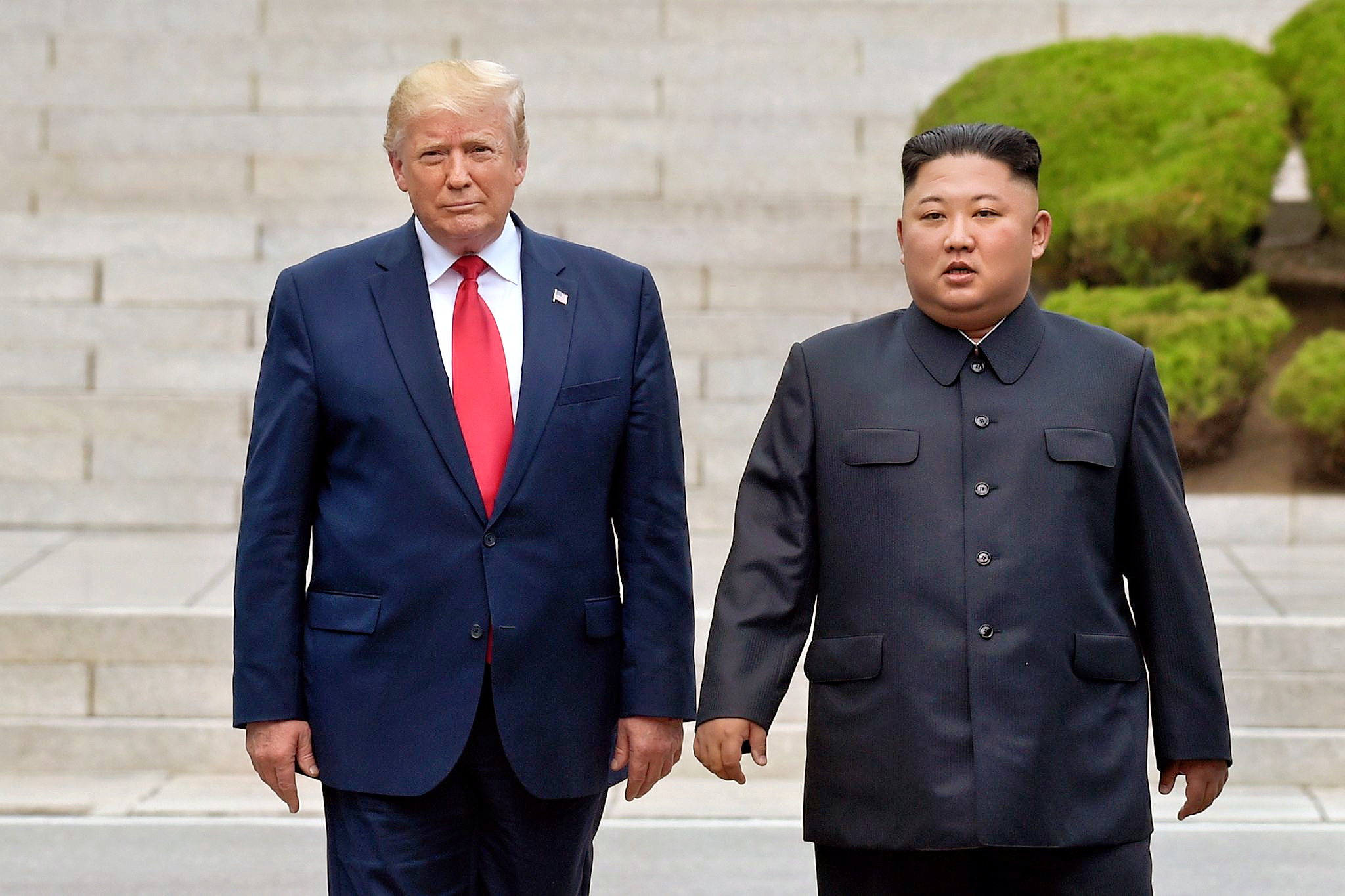
Photo at top: President Donald Trump greets North Korean leader Kim Jong Un on the North Korean side of the border at Panmunjom in the Demilitarized Zone, on June 30, 2019.

Photo at top: President Donald Trump greets North Korean leader Kim Jong Un on the North Korean side of the border at Panmunjom in the Demilitarized Zone, on June 30, 2019.
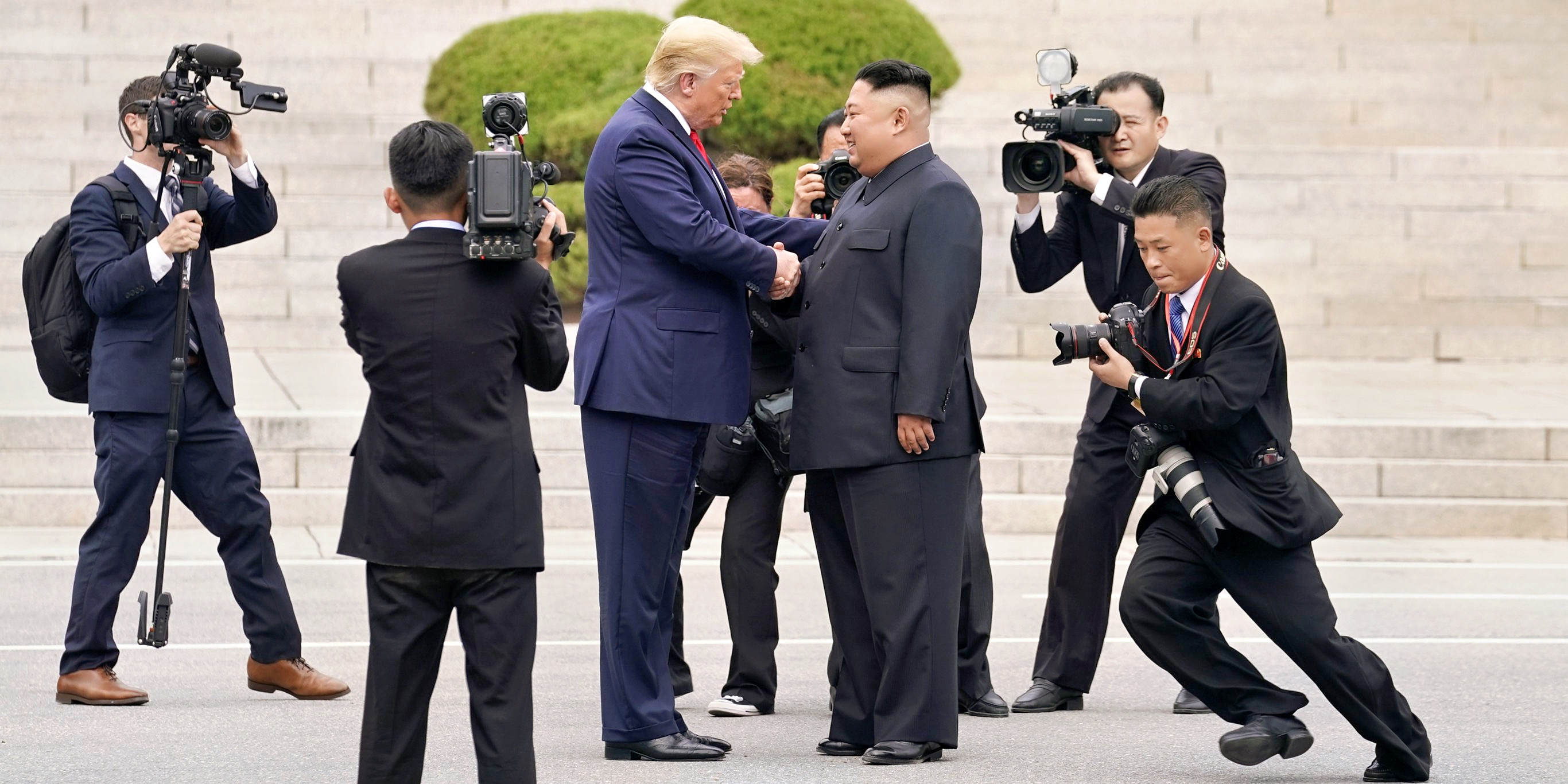
Photo at top: President Trump briefly steps inside North Korea at Kim Jong Un’s invitation, surrounded by North Korean press, in the Joint Security Area, at Panmunjeom, June 30, 2019.
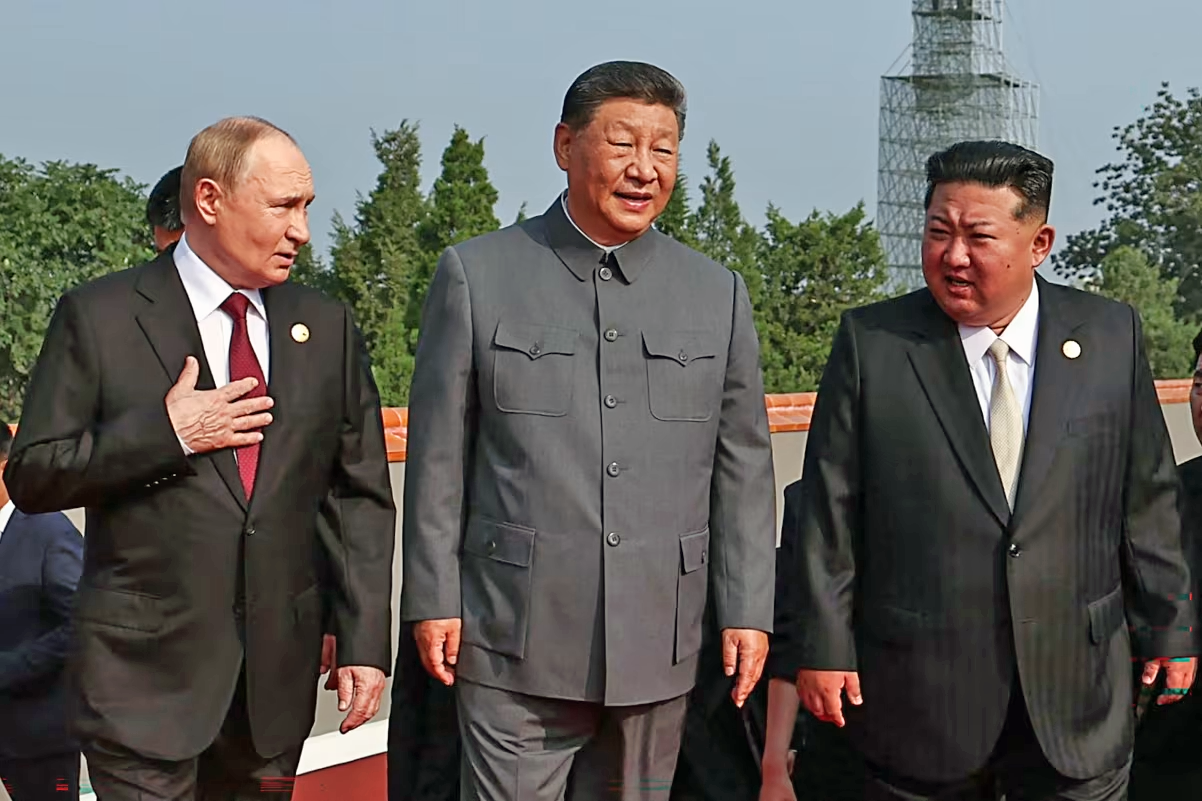
Photo at top: Russian President Vladimir Putin walks with Chinese leader Xi Jinping and North Korea’s Chairman Kim Jong Un prior to a large military parade marking the 80th anniversary of the end of World War II in Beijing, September 3, 2025.
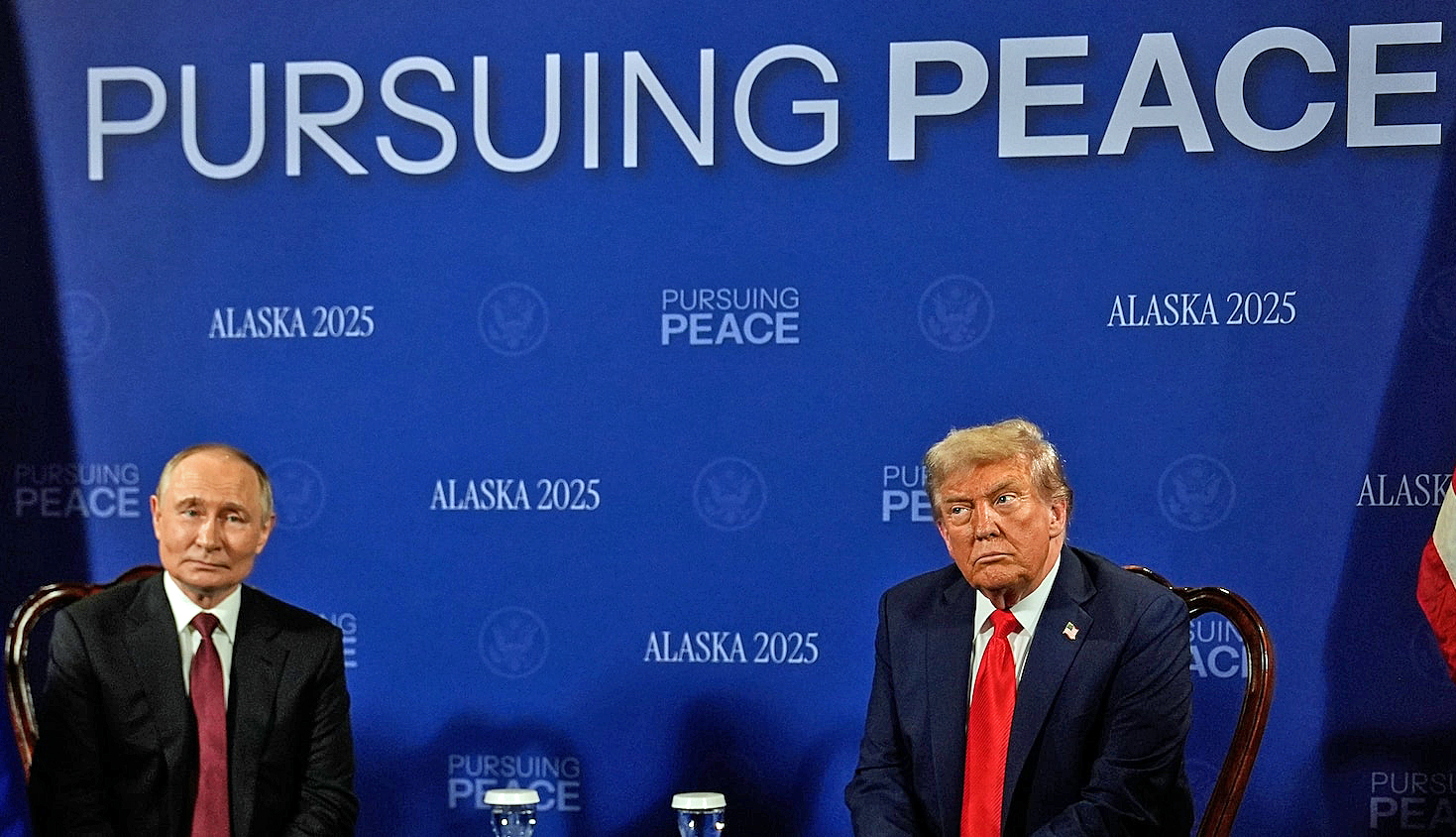

Photo at top: President Trump meets Russian President Putin in Anchorage, Alaska, August 15, 2025.
DPRK President Kim Il Sung (1912-94) is said to have met thousands of foreigners, but comparatively few Americans. Those Americans include:
Affiliation at time of meeting; year(s) met; (d) = deceased
After DPRK independence in September 1948:
• Harrison Salisbury, New York Times (interview with Kim), (article), 1972 (d)
• John M. Lee, New York Times, 1972 (d)
• Selig Harrison, Washington Post (article and interview with Kim), 1972, Carnegie Endowment, 1994 (d)
• Rep. Stephen Solarz, 1980, 1991 (d)
• Ralph Clough, SAIS, 1980, 1991 (d)
• Stanley O. Roth, House Foreign Affairs Committee, 1991 [Roth accompanied Solarz to Pyongyang; as Assistant Secretary of State for EAP, Roth also met Kim Jong Il in 2000]
• Rev. Billy Graham (with Dr. Stephen Linton and other members of the Graham delegations) 1992, 1994 (for Graham’s accounts of meeting Kim, see Ch. 34 in Just As I Am: The Autobiography of Billy Graham) (d)
• Former Rep. Richard Ichord, American Freedom Coalition (AFC), 1992 (d)
• Former Rep. Bob Mathias, AFC, 1992 (d)
• Amb. John Holdridge, AFC, 1992 (d)
• Amb. Douglas MacArthur II (the General’s nephew and namesake), AFC, 1992 (d)
• Max Hugel, former Deputy Director, CIA; AFC, 1992 (d)
• [The AFC delegation that met Kim in May-June 1992 included approx. 40 participants, among them former U.S. congressmen, governors and other senior officials]
• Dr. Robert Grant, AFC, 1992
• Gary Jarmin, AFC, 1992
• Dr. Thomas J. Ward, AFC, 1992
• Larry R. Moffitt, AFC, 1992
• Dr. William J. Taylor, Jr., CSIS, 1992, 1994 (d)
• Josette Sheerhan, Washington Times, 1992 (article and interview with Kim), 1994 (written interview with Kim)
• Victoria Yokota, Washington Times, 1992
• Rep. Gary Ackerman, 1993
• [Ackerman was accompanied by two congressional staffers, and State’s Kenneth Quinones (see his report)]
• Dr. C. Kenneth Quinones, State Dept., 1993
• Eason Jordan, VP, CNN International, 1994 (twice in April and June)
• Mike Chinoy, CNN, 1992, 1994 (see Ch. 11 of China Live: People Power and the Television Revolution)
• Lt. Col. James G. Zumwalt (USMC, Ret.), 1994
• Dr. Antonio Betancourt, Summit Council, 1992, 1994 (5 times total) (d)*
• Dr. William P. Selig, Summit Council, 1992 [also met Kim Jong Il]
• Dr. Mark P. Barry, Summit Council, 1994
• Former President Jimmy Carter (d) and Rosalynn Carter (d), 1994
• Richard A. Christenson, State Dept., 1994
• Nancy Konigsmark, Carter Center, 1994 (d)
• Amb. Marion Creekmore, Carter Center, 1994
The above DPRK video includes Kim meeting Rev. Billy Graham, Selig Harrison and former President Jimmy Carter. Also, the international delegation I accompanied in April 1994 is shown around the 4:30 mark; I’m in the back row, third from the left, of the group shot (just like the header photo at top on the home page).
Before DPRK independence in September 1948 (thanks to Koryo Tours for this info):
• William R. Langdon, Political Counselor to Gen. John R. Hodge, USA, in Korea (October 1946)
• Major General Albert E. Brown, USA, Chief Commissioner, American delegation to the US-USSR Joint Commission, plus members of the U.S. delegation to Pyongyang (July 1947)
*=also attended Kim Il Sung’s funeral in July 1994, and twice met Kim Jong Il in 1992, 1994
→ Does not include the names of U.S. citizens who were likely part of CNN’s crews in its 1992 and 1994 visits (e.g., Mitch Farkas) in which they met Kim Il Sung, nor the name of an individual who met Kim Il Sung and Kim Jong Il while a Soviet diplomat. Also does not include the names of any Communist Party USA (AKFIC) members who may have met Kim (AKFIC at least got a written response to interview questions); CPUSA head Gus Hall once received a box of presents from Kim. Black Panther leader Eldridge Cleaver visited North Korea twice in 1969-70, but may not have met Kim himself despite his subsequent praise of the regime. For the names of several Korean-Americans who met Kim, likely among at least dozens, please confer Dr. Myers’ comments below.♦
👉🏻New biography of Kim Il Sung: Accidental Tyrant: The Life of Kim Il-sung by Fyodor Tertitskiy (published April 1, 2025 in the U.S.; I am cited in the endnotes for my article on the 1945 division of Korea):


Here are notes for my response to Question 7 in the interview, which was cut for time:
7. (BARRY) Meanwhile, after the recent U.S. airstrike on Iran’s nuclear facilities, some analysts now believe that achieving “complete, verifiable, and irreversible denuclearization” (CVID) of North Korea is no longer realistic. What message did this military action send to Pyongyang?
“The U.S. won’t publicly jettison its long-held CVID policy because Trump hasn’t offered any new policy whatsoever. But Trump may eventually have to offer security guarantees and liaison offices as steps to normalize relations with North Korea and to ensure they handle their nuclear weapons responsibly. Kim had to have been affected by the sudden and unprecedented American bombing of Iranian nuclear sites, but more importantly, he surely was disconcerted by Trump’s public flirting with the idea of regime change in Iran. That threat of regime change, however distant for the DPRK, is precisely why Kim sought a mutual defense agreement with Russia. Yet, Trump is full of surprises: in May, he met Syria’s new president while in Saudi Arabia, and Monday, he lifted U.S. sanctions on Syria.”
Photo at top: Kim Jong Un kneeling over a coffin of a dead North Korean soldier who presumably died fighting against Ukraine, with Russian diplomats and military officers in the background at a Pyongyang concert (screen capture taken from KCTV, June 30, 2025).
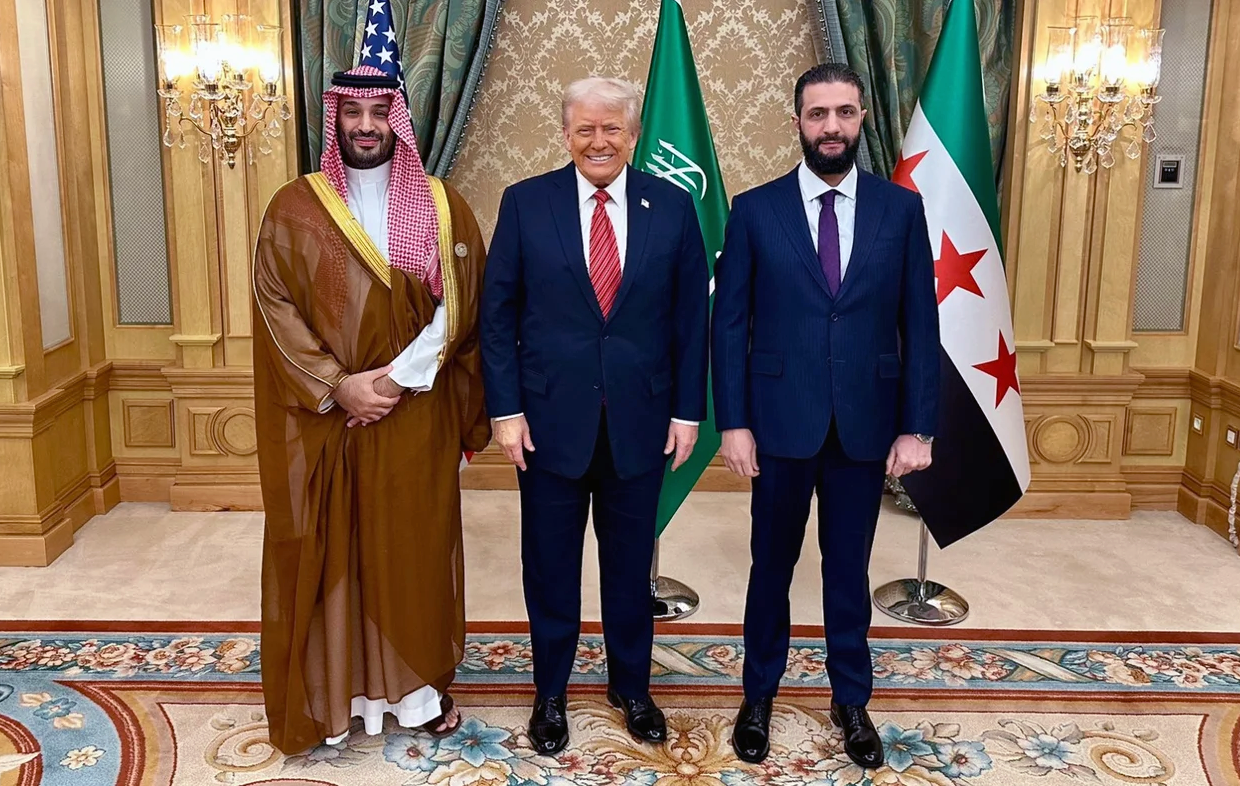
Photo at top: Saudi Crown Prince Mohammed bin Salman, President Donald Trump and Syria’s President Ahmed al-Sharaa meet in Riyadh on May 14, 2025

Photo at top: Kim Jong-un, alongside his daughter Ju-ae, attends a ceremony in Pyongyang’s Hwasong area on April 15, 2025, to mark the dedication of 10,000 apartments in a newly developed area on the birth anniversary of his grandfather Kim Il-sung.
Click animated GIF below (no sound; H/T to Ian Bremmer; unfortunately animated GIFs not yet supported on Bluesky):
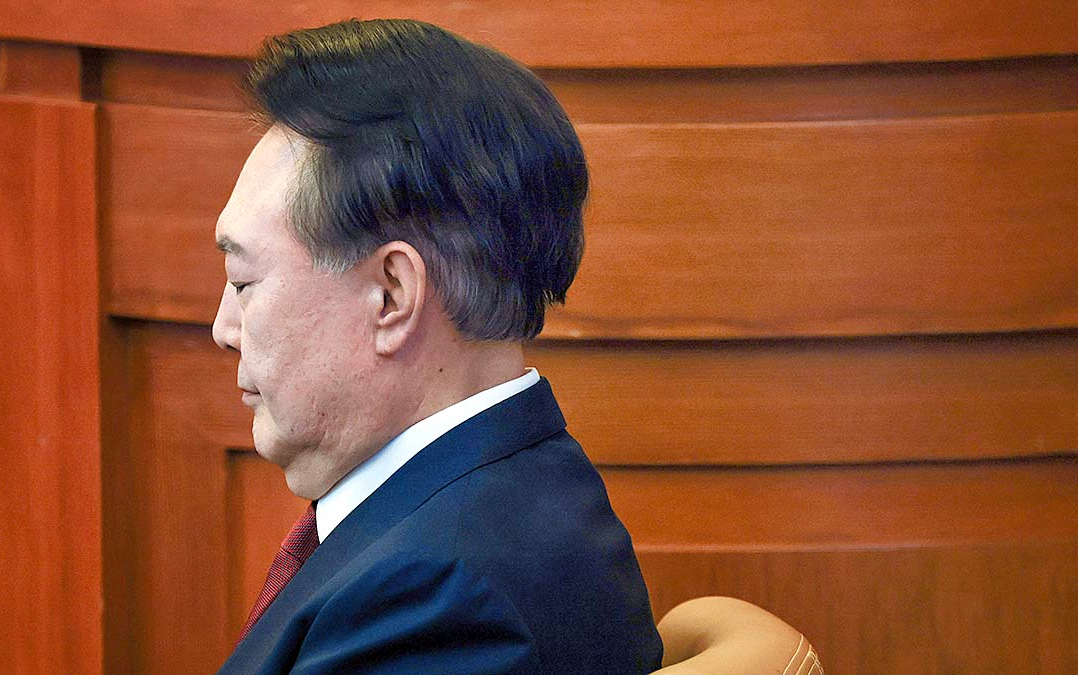
The Constitutional Court’s ruling on Yoon’s impeachment will be announced at 11 a.m. KT on April 4 (10 pm ET April 3). Here is Arirang News’ outline of three verdict scenarios:
The Constitutional Court’s ruling on President Yoon Suk Yeol’s fate comes tomorrow. The president will be absent. Our correspondent Oh Soo-young explains potential scenarios on Friday:
“The fate of President Yoon Suk Yeol and the nation hangs on the Constitutional Court’s decision on his impeachment Friday. The ruling will mean immediate consequences regarding the governance of the country as the leader’s removal or reinstatement spells out very different outcomes.
If the Court upholds the impeachment, Yoon would become the nation’s second president in history to be removed from office—following Park Geun-hye’s impeachment eight years ago. Effective immediately, Yoon would have to vacate his office for good and leave the official residence in Yongsan-gu District. He would lose all post-presidential privileges—no pension, no office, no staff support, and no burial rights at the National Cemetery. His protection would be limited to basic personal security. With the leadership vacuum made permanent, Prime Minister Han Duck-soo would continue as Acting President until an early election is held within 60 days.
On the flip side, if the impeachment is dismissed with prejudice it would mean the Court has found the National Assembly’s grounds for his removal insufficient and the case is closed for good. After over three months of suspension, the President would immediately resume his duties. It’s expected he’d then address the public through a televised message or press conference.
His first tasks back in office are likely to focus first on foreign policy and national security, as there has not been top-level engagement with the United States since President Donald Trump’s inauguration. Yoon would also begin laying out proposals for constitutional and political reform, as pledged during his final court appearance.
While his impeachment case would be closed for good, Yoon would still face investigations regarding his Dec. 3 Martial Law declaration, but during his presidency, would be immune from charges other than for treason and insurrection.
Another scenario is the Court dismissing the case without prejudice. The case would be dropped due to legal or procedural issues, meaning the bench decided not to rule on the grounds or evidence presented. The President would return to office, but the National Assembly could reattempt impeachment in the future.
Six or more justices must consent to uphold an impeachment. Three or more justices deciding against impeachment would lead to a dismissal.
While sources say the justices have reached an understanding on the verdict, the bench is expected to sign off their decision at the last minute, either the evening before or early in the morning of the ruling, to maintain utmost confidentiality.
The ruling takes legal effect the moment the presiding justice reads the decision on live TV.
President Yoon’s lawyers told the press on Thursday that the suspended leader has decided not to go to the Court to hear his verdict in person, taking into the account the need to maintain public order, and presidential security arrangements.
In past impeachment cases, former Presidents Park Geun-hye and Roh Moo-hyun did not attend their ruling sessions either.
Oh Soo-young, Arirang News.”♦
 Mark P. Barry's Blog