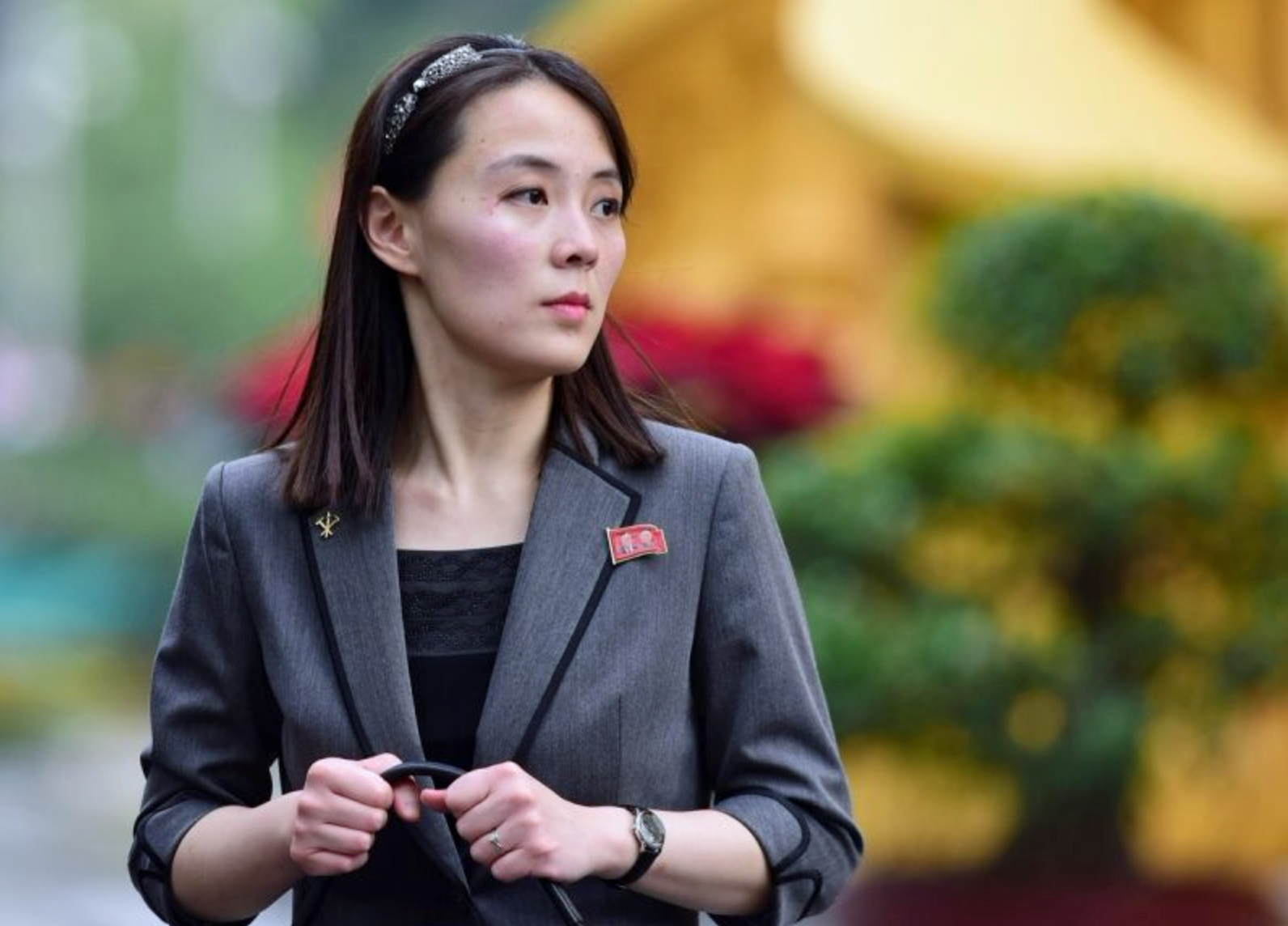
An adaptation of my emailed comments to Radio Free Asia’s Korean service today on Kim Yo Jong’s warnings to the U.S. and ROK on joint military exercises:
I liken Kim Yo Jong’s (younger sister of Kim Jong Un) March 16 comments as almost comparable to having a Twitter account, only she speaks through official state propaganda organs. Her comments, directed mainly at the ROK but also to the U.S. on the occasion of Secretary of State Blinken’s and Defense Secretary Austin’s joint visit to the region, are much more colorful than other spokespersons for the DPRK, but the threats she makes themselves don’t seem much different. It seems after four years of Trump, it’s more permissible to name call as part of normal international politics. But for Kim Yo Jong, she has developed a distinctive, shrill voice since last June, when the inter-Korean liaison office was demolished.
Overall, North Korea is afraid that no movement will be possible under the Biden administration because it seems only to wish to contain and manage the problem of the North’s nuclear program, but not solve broader political problems. Even though it is not finished with its policy review for North Korea, the U.S. has already implied it does not necessarily place much credence in the Singapore Declaration signed by President Trump. The DPRK is concerned the U.S. will not honor the Singapore Agreement as a baseline because the U.S. will allege that the North has not seriously abided by the spirit of the agreement.
If the U.S. is not willing to recognize the Singapore Agreement as a baseline, then the Biden administration will essentially be relegating the entire Trump diplomacy with Kim Jong Un, including Hanoi and DMZ summits, as well as presidential correspondence, to irrelevancy. In effect, North Korea is afraid the U.S. will revert to an Obama-era policy, but with a much stronger emphasis on containing China, in alliance with South Korea and Japan. This leaves resolution of outstanding issues with North Korea by the wayside.
Meanwhile, an advantage of the COVID-19 lockdown, regardless of how seriously concerned the DPRK is about the influx of the disease from beyond its borders, is that it has forestalled continued penetration of the North’s economy by China. It has given Kim the opportunity to buy time to prevent increasing Chinese economic and political pressure from irreversibly affecting DPRK sovereignty and independence. This is the reason North Korea continues to seek agreement with the U.S., not just to relieve UN sanctions, but to offset Chinese pressure with an improved relationship with the U.S. But the U.S. appears unwilling to acknowledge there may be an opportunity for it and instead sees things in pre-2018 terms.
It’s a pity that Trump would not concede to Biden after the November election and receive him as president-elect in the White House so Trump could have informed Biden about the benefits he saw of building upon his own relationship with Kim Jong Un, and Trump could have even urged Kim to feel confident he could make a deal with President Biden.♦
 Mark P. Barry's Blog
It’s no good just focusing on government-to-government agreements with North Korea because they can be thrown away too easily, and there is still the prevailing opinion of the people to be overcome, which is where I think the US should be focusing to build up ties and change perceptions.
Kim Jong Un needs to see a potential role or life after reunification, and it had better not be the totalitarian leader of a reunited Korea! So I think it would be good for people to start doing some realistic outreach with that in mind. The Gorbachev Foundation could send a delegation to Pyongyang to discuss the future of nuclear weapons, as could the Berggruen Institute, and move to cast him in the light of a last-minute rescuer, someone uniquely placed to make proposals toward eventual universal disarmament of all nuclear powers, for instance. The Berggruen Institute already meets with Xi Jinping, so they would be perfect to reach out to KJU. I think helping him to feel they see his potential on the good side might help him move in that direction.
KJU has quite a record if you think about it, educated in Europe, inheriting a country that no one thought he could keep control over, and moving it forward into a position where it can’t be ignored. He studied at Kim Il Sung University, and has at least some military knowledge, although not personal military experience. He’s done bad things. I think KJU will face his record at some point, but let him do something good for the world until then, and use his skills to manipulate China, Russia, and America into a new post-nuclear world, or at least much-reduced nuclear.
(Note: The author is Senior Lecturer in Physics at Widener University, with ten year’s teaching experience in South Korea)
LikeLike