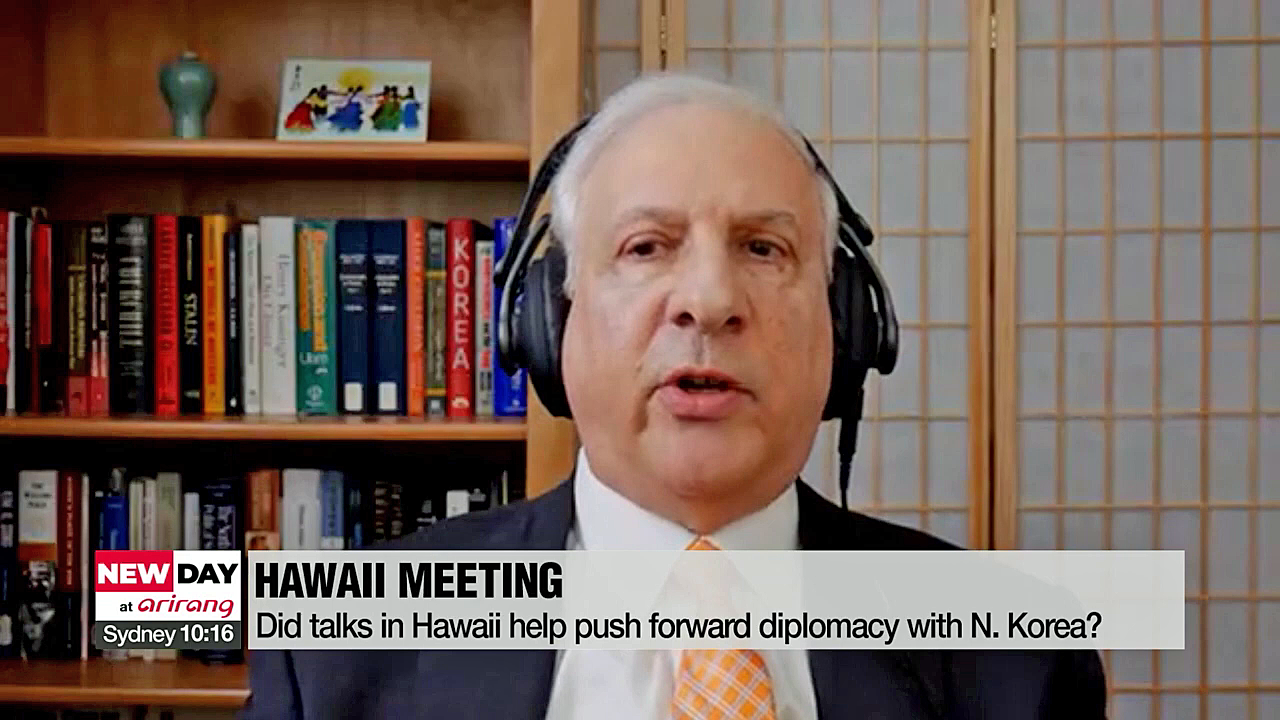
I was again interviewed today by Arirang News “New Day” program about the U.S.-Japan-South Korea meeting of foreign ministers and Secretary of State in Honolulu that took place on Saturday:
Here is an approximate transcript:
Last weekend, the top diplomats of South Korea, the United States and Japan declared a united front against North Korea after a rapid-fire series of ballistic missile launches by the regime throughout the month of January. Describing the launches as “destabilizing,” the diplomats also said North Korea must “cease its unlawful activities and instead engage in dialogue.” The three sides reiterated their commitment to the denuclearization of the Korean Peninsula, and their readiness to resume talks with the North. However, the regime has continually rebuffed overtures for talks from the Biden administration over the past twelve months. For more, we connect to Mark Barry, the Associate Editor of the International Journal on World Peace.
1. Firstly I’d like to get your reaction to the Hawaii talks as well as your thoughts on whether they are likely to move the needle in terms of diplomacy with North Korea?
This was a do-over from November when a trilateral meeting of deputy foreign ministers in Washington concluded with a one-person press conference by Wendy Sherman. There arose a behind-the-scenes dispute between Japan and SK over a territorial issue, which led to the appearance of a fractured trilateral alliance. This time the three nations gave the outward appearance of unity on NK in Honolulu, but internally I suspect much time was spent discussing US insistence of greater cooperation against China, reducing dependency on Chinese trade, and for SK, participation in Quad activities. So internally and outwardly I think there were two different tracks going on. SK reportedly offered some new ideas to engage NK, and then at the joint press conference, one Korean reporter asked a great series of questions on innovative approaches to the North, which unfortunately did not get a clear answer.
2. North Korea has refused to listen to any U.S. offers to resume talks since President Biden took office. It insists it’ll not return unless Washington drops what it says are hostile polices. What are these U.S. policies that the North considers to be “hostile”? And can you see why the North sees it that way?
Under Biden, there was the Treasury designation last month of 6 NK citizens to be sanctioned who were involved in procuring materials for missile development; and in December the designation of the DPRK minister of defense as well as an animation studio earning foreign currency. Also there has been talk of additional US sanctions and of resumption of regular joint US-ROK military exercises. Finally, I think, the nomination of Amb. Philip Goldberg, a former UNSC sanctions enforcer, as ambassador to Seoul, doesn’t assure the North. NK is really saying the US continues to have little to offer, that the US still wants it to give up its defensive weapons and military secrets for vague promises of what it might do in return. The US comes across to NK, worse than it did 30 years ago, as essentially making ultimatums, while the North aims to counterbalance Chinese pressure with ties with the US, but accepted as a permanent nuclear power not a junior power.
3. These talks happened as most of the international community’s attention is focused on Ukraine. Considering the geopolitical situation, do you think North Korea has slipped further down the Biden administration’s list of priorities? And if so, do you expect North Korea to get back on Washington’s radar?
If Ukraine is invaded soon, that may affect NK’s overall strategy, depending on the US response. Otherwise, I expect they’ll wait until after the Olympics, then test more missiles, although they’ll likely be more of the IRBM, SLBM or claimed hypersonic variety, not an ICBM. This will continue past the March 9 presidential elections, past the 110th birthday of Kim Il Sung on April 15, and maybe until the new ROK president is inaugurated in early May. By late May, Biden arrives in Japan for a Quad summit and meeting with PM Kishida, and may then fly to Seoul to meet the new ROK president. But I think the North will continue to abstain from nuclear tests because that will turn China and Russia against them, forcing them to cooperate on more stringent sanctions.
4. Finally, China is generally seen as the key to resolving the North Korea issue, but given how tense U.S.-China relations are right now, do you think this means little to no meaningful progress will be made… no matter how hard Seoul, Washington and Tokyo try?
China was only helpful in the “fire and fury” days of 2017, or back during the 6 party talks of 2005-08, but they’ve never been key to solving the nuclear issue because the North strongly distrusts them. Nonetheless, China insists NK has legitimate security concerns and interests, and urges tension reduction and negotiation with the North. Russia takes a similar tone that creating a toxic atmosphere of pressure makes it very unlikely the North will cooperate, and rather it will redouble its efforts. In the past, China has used its appearance of influence with NK to put the US in China’s debt, but in fact it has little political influence and the North Koreans resent Chinese attempts to interfere in the North’s foreign relations. Moreover, the US is now unlikely to ask for Chinese assistance with the North, as it may have done in prior administrations.♦
 Mark P. Barry's Blog