
The U.S. Presidential Election and Future American Policy toward North Korea
Associate Editor Emeritus, International Journal on World Peace
[Bullet points prepared for delivery at an international forum at the Lotte Hotel, Seoul, Korea, Sept. 4, 2024]
- I’m a native New Yorker who has followed Donald Trump’s career through the media since the early 1970s. Many New Yorkers like myself can fairly confidently say, “We know this guy. We know how he thinks and behaves,” and we can apply that experience to what’s happening in 2024.
- The most important fact is that Trump almost never accepts advice from others (although he can certainly appropriate ideas from others as his own). He makes his own decisions, even when his National Security Advisor, Secretary of State and Secretary of Defense are all in the room telling him otherwise (as H.R. McMaster recounts in his new book).
- Don’t listen to what so-called Trump spokesmen visiting Korea (or when you visit Washington) might tell you about future Trump policies if he is re-elected. They don’t speak for Trump, and, in fact, that they say they reflect his views almost surely guarantees he’ll throw them under the bus in the future.
- Regardless of what you hear or read, keep several things in mind:
- The 2020 election was decided by only about 47,000 votes in the key battleground states. That determined the Electoral College outcome, which is why both campaigns are feverishly working in the key swing districts of the seven battleground states.
- Polls regularly undercount those likely to vote for Trump as many respondents won’t admit they plan to vote for him. But if you listen to conversations at diners and coffee shops, you can feel the strength of his support. Where I live 100 miles north of New York City, just days after the first presidential debate in which Biden did so poorly, I heard a group of diners in a restaurant confidently boast that this time Trump is going to win New York and New Jersey, normally reliably blue states. Though this was said prior to Biden withdrawing his candidacy, their point was the animus by a large group of voters toward Democrats is so strong that Trump could decisively win.
- Trump
most likelywillshowed up for his September 10 presidential debate in Philadelphia. It may or may not be the only Harris-Trump debate, depending on outcome. But early voting will nonetheless begin by mid-September. - New York State Judge Juan Merchan, after ruling
on Sept. 16whether the U.S. Supreme Court’s decision on presidential immunity shields Trump, will decide whether to re-schedule Trump’s sentencing, currently set forSept. 18, in his hush-money trial conviction. Since the Manhattan district attorney has deferred to the judge on a sentencing delay, while maintaining further delay is unnecessary, the judgemaywill postpone sentencing until after Nov. 5, partly to avoid the appearance of election interference as well as to allow the defense time to digest his ruling on immunity.But the judge may only postpone sentencing until early October: an October surprise.[Update: On Sept. 6, the judge postponed Trump’s sentencing, if necessary, until Nov. 26, while the immunity ruling is rescheduled for Nov. 12.] - Outside factors: If there is not a ceasefire soon in the war in Gaza, then it’s possible Iran and Hezbollah will again escalate attacks against Israel, which will involve the U.S. and could go on for weeks or months. Harris would see a drop in poll numbers not only among Arab-Americans in Michigan but American Jews as well, while Trump will claim he would have never let these things happen.
- If the election desks of major media call the presidential election for Harris late on election night or the morning after, Trump’s campaign and the Republican Party, as has been well-reported by The New York Times and other news organizations, is fully prepared to challenge the vote-counting at the county level in the key battleground states through the state and federal judicial systems. We will see echoes of both 2020 and even 2000, where at best, the Supreme Court may again have to decide the election, and at worst, several states could be unable to certify their electoral votes, creating a constitutional crisis.
- If the election is projected for Vice President Harris on Nov. 5-6, the two months between Nov. 6 and Jan. 6 will be a very contentious and uncertain period for the United States.
- In short, Donald Trump does not plan on conceding if he loses, and he will put relentless legal pressure on the American judicial system to be declared the winner by January 6, 2025.
- Turning to the Koreas: If Trump is re-elected, he will largely ignore Biden Administration policies toward both Koreas, and institute his own, especially after he likely meets President Yoon in a Washington visit in spring 2025.
- However, first Trump will focus on ending the war in Ukraine by demanding that both Putin and Zelensky agree to a ceasefire quickly leading to a settlement. He will pressure Ukraine with threats of an end to all future arms shipments.
- Afterwards, he may tell Putin he wants to bring about a reduction in tensions on the Korean Peninsula and he asks for the Russian president’s active cooperation.
- When Trump meets Yoon, he will likely say inter-Korean tensions have become parlous since 2021 — and would not have occurred if he had been president (something Trump has told Korean audiences by video since late 2021). Trump would inform Yoon that current ROK policy greatly exacerbates tensions with Kim Jong-un and has to stop.
- He will urge Yoon to make the determination, and requisite effort, to meet with Chairman Kim Jong Un and find a way to get along.
- Moreover, Trump may tell Yoon that he is willing to make a deal with Kim, and let him keep a few nuclear weapons and only short-range missiles, in exchange for the U.S. ceasing all military exercises with the ROK, and possibly commencing a major American troop drawdown over four years.
- Trump will likely tell President Yoon that “Korea is a rich country and you’re selling the latest weapons around the world. You no longer need U.S. troops on your soil and I have to save American taxpayers money. So I intend to draw down the numbers of our troops over four years and maybe leave just a few hundred there permanently.”
- If Kamala Harris becomes President, she will initially continue Biden administration policy, and so inform President Yoon when they meet, presumably by spring next year. This includes trilateral cooperation with Japan, as begun at the 2023 Camp David summit.
- A President Harris would continue backing Ukraine in the short-term, but within her first year in office, we should expect a multilateral push for a settlement between Russia and Ukraine, which would be driven by domestic political sentiment in the U.S.
- In the Middle East, if Harris succeeds in re-shaping Israeli behavior toward Gaza and the West Bank (depending on whether Biden leaves office with a permanent ceasefire and hostage release in Gaza), and gets new Israeli leadership to publicly commit to an eventual two-state solution, she may then focus on how she can foster permanent peace on the Korean peninsula after over 70 years of a technical state of war.
- Given that so much has changed since the Korean Armistice took effect in 1953, as the first woman U.S. president, and rather than continuing to merely manage the conflict, Harris could push for a comprehensive peace settlement in Korea, including a multilateral peace agreement, along with arms control measures and security guarantees.
- However, it’s hard to see her focusing her energies on Korean peace until at least midway in her term, after the 2026 midterm elections, and possibly after a new president takes office in the ROK in May 2027.
- Her biggest challenge will be managing relations with China, along with her vice president, Tim Walz. She may need to carry out a sequel to Nixon’s 1972 efforts to separate China from Russia.
- We are in a decisive period of history, I believe even more decisive than the hugely eventful period of July-August 1945 that had such long-lasting impact upon the Asia-Pacific.♦
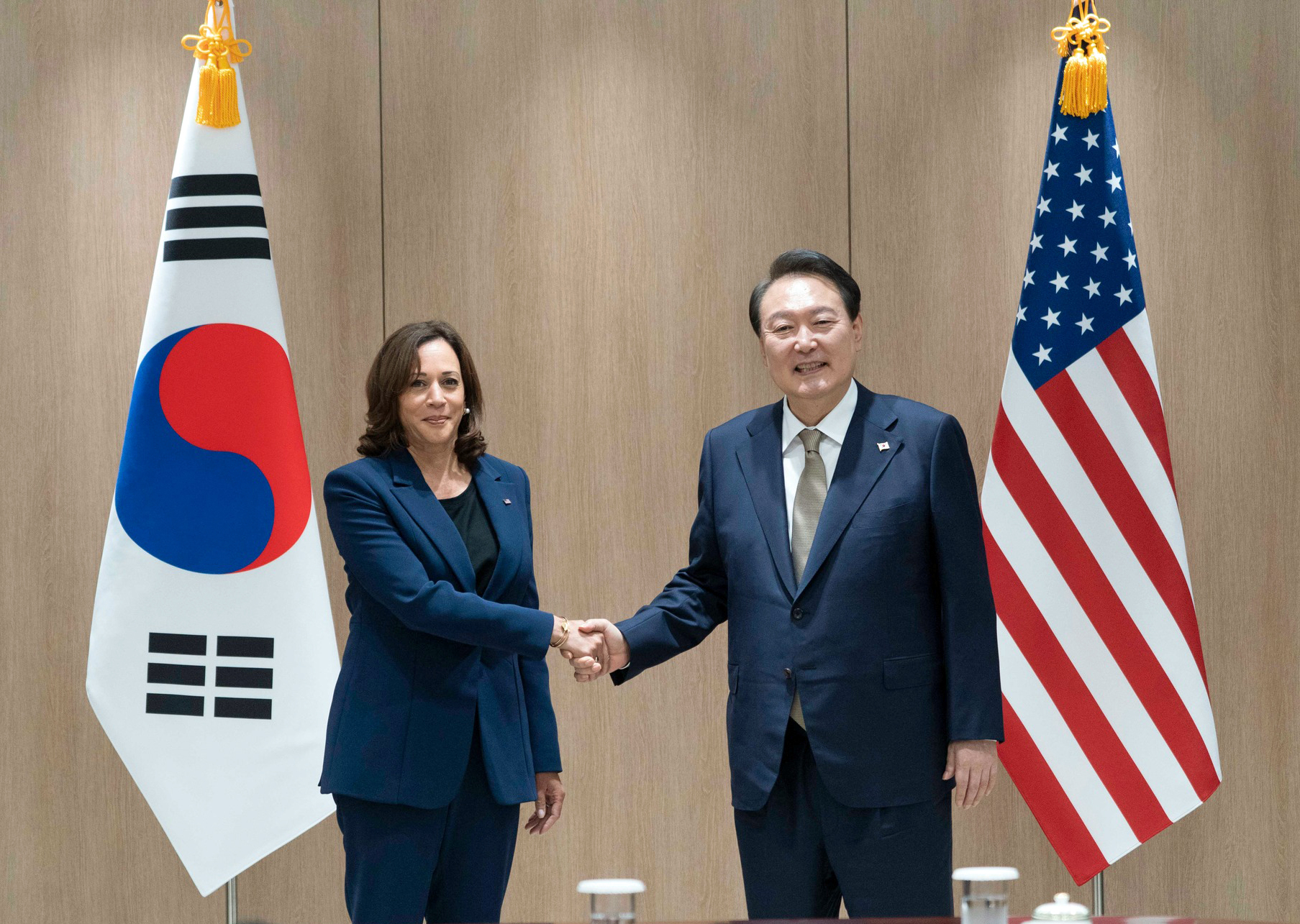
Photo at top: U.S. Vice President Kamala Harris meets ROK President Yoon Suk Yeol on Sept. 29, 2022. She is now the Democratic Party candidate for President in 2024.
 Mark P. Barry's Blog