My comments to Radio Free Asia on leaflet balloons to North Korea, Kim Yo Jong’s enlarging role, and possibility of inter-Korean accommodation in a new Northeast Asian environment

3586

These are my full emailed comments to Radio Free Asia today. I don’t know how much they will use, but thought I’d get it out there as soon as I could:

I had thought that sending balloons with leaflets to North Korea had stopped two years ago. In any case, I do not believe they effectively reach North Korean people, not in the way that smuggled USB sticks and microSD cards can (containing video/audio content they want to see). A North Korean citizen picking up a leaflet that lands could be arrested if seen, and his/her family punished. I believe this is merely publicity for those sending the balloons and those that back them; it makes for good photos and YouTube videos. This leaflet activity does not truly help the North Korean people; it helps the South Korean groups sending the balloons and it is a tool for domestic South Korean politics. In any case, it’s not clear to me that the ROK government will in fact do anything about it in the longer run.

But I see a much bigger story here, and it comes from my gut feeling rather than clear-cut evidence:

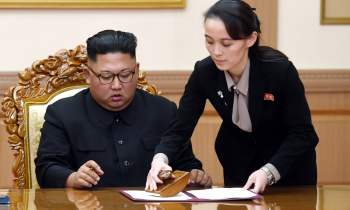
I’m beginning to think Kim Yo Jong may become the day-to-day leader in North Korea, on behalf of her older brother, who will – for whatever reason – appear much less often. I see that look in her face, as if that responsibility has already been put upon her.

And Kim Jong Un may send his sister to the South again, like in February 2018, to discreetly propose that the two Koreas come up with mutually supportive policies to deflect Chinese pressure upon both Koreas and to deal with the likelihood of a progressive withdrawal of the United States from safeguarding the ROK (and in fact the Korean peninsula). In my experience, in private, senior DPRK officials have never objected to some U.S. troop presence in the South because it has kept the Armistice intact (i.e., prevented another war) and it functions as leverage against Chinese encroachment.

The writing on the wall, Kim Jong Un may sense, is that China will make moves this year and next year to progressively diminish North Korea’s economic and political sovereignty, which the U.S. may not bother to prevent because of President Trump’s intention to reduce overseas engagement and, in particular, compel the ROK to defend itself on its own while drawing down U.S. Forces Korea if re-elected.

In such an environment, despite the overt North Korean attacks on South Korea, what may really be happening is Kim could be discreetly attempting to reach out to President Moon in the remaining months of his presidential term to create a new modus vivendi — an accommodation — that would enable the two Koreas to work more in tandem (although not in unison) to deflect Chinese pressure upon the peninsula in an enlarging vacuum created by U.S. retreat. This could lay a basis for more consistent inter-Korean policy cooperation and later ongoing partnership.

They will be stronger together than apart. And Kim Yo Jong may have her work cut out for her internally and with regard to South Korea in the months ahead.

Again, this is my gut feeling, but I do think North Korea watchers need to discard old notions in a fast-changing environment.♦
 

My Arirang News interview on the second anniversary of the Panmunjeom Summit

2018_inter-Korean_summit_01

I was interviewed this morning (Seoul time) on Arirang News Global Insight on the second anniversary of the Panmunjeom Summit, along with Dr. John Nilsson-Wright, senior university lecturer in international relations at Cambridge University, and Lt. Gen. Chun In-bum, ROK Army (Ret.). Many thanks again to Oh Sooyoung for putting together a great segment.

My Arirang News interview on Kim Jong Un’s health status and North Korea’s handling of COVID-19

vlcsnap-2020-04-22-10h25m48s681

My commentary today (Korea time) on Arirang News’ daily morning interview program Global Insight,” along with Jeongmin Kim, Seoul correspondent for NK News. Many thanks to anchor Oh Sooyoung for organizing this segment on matters that are very daunting to confirm.

My Comments to Radio Free Asia on April’s Supreme People’s Assembly Meeting

Spa-session-935x500

My emailed comments were included in two Radio Free Asia Korean service articles written before and after the Supreme People’s Assembly meeting on April 12. Many thanks to writer Albert Hong.

Original April 6 article in Korean:

“북 최고인민회의 관전 포인트는 인사이동”

English machine translation:

https://www.translatetheweb.com/?from=&to=en&dl=en&ref=trb&a=https%3A%2F%2Fwww.rfa.org%2Fkorean%2Fin_focus%2Fnk_nuclear_talks%2Fsupremepeoplesassembly-04062020152040.html

Original April 13 article in Korean:

“북 최고인민회의 전 코로나19 철저한 검사 이뤄졌을 것”

English machine translation:

https://www.translatetheweb.com/?from=ab&to=en&a=https%3A%2F%2Fwww.rfa.org%2Fkorean%2Fin_focus%2Fspacorona-04132020153332.html

My comments in full provided to Radio Free Asia:

April 6 comments:

“The upcoming SPA meeting is significant in that it is being held during a global pandemic, as a way of showing that North Korea is functioning normally. If attendees do not wear masks, that will be telling. Of course, it is customary to hold an SPA meeting prior to Kim Il Sung’s birthday. Budgets will be discussed and some personnel reshuffles announced. Kim Jong Un may address the SPA, but we will know only after the fact. The summary of his speech, if given, by KCNA will be the most significant outcome of the SPA, whatever its content. But I do not expect any surprises, except surely the economy has taken a hit by the reduction in trade with China and we do have to be concerned about food security this spring, in addition to the actual public health impact of COVID-19.”

April 13 comments:

“I believe that the SPA was postponed by two days mainly so each participant could be thoroughly checked for temperature and other signs of COVID-19 symptoms. Indeed, there were no masks, no Photoshopped masks (as has been the case with many KCNA photos), and no effort to leave empty seats between SPA members (social distancing). The SPA was intended to portray business as usual — no DPRK problem with COVID-19 cases. However, Kim Jong Un staying away from the SPA meeting and only presiding over the Politburo meeting of about 30 people probably was intended as a precautionary measure to limit his exposure to just a few medically-cleared officials. The DPRK evidences clear awareness of the dangers of COVID-19, but claims 100% success in preventing an outbreak due to its efforts to close borders and quarantine those who may exhibit symptoms. Their emphasis has to be on Pyongyang, where an outbreak would have the most serious impact and would be eventually known to the outside world.”

Out of Pride, North Korea Never Cries Out for Help

nk-masks-crop

My Twitter thread of April 3:

In December 1994, at the earliest signs of North Korea’s famine, my colleague, an NGO leader in Washington, DC, was asked by Kim Jong Il’s inner circle if he could request food assistance for the DPRK from European capitals. The European diplomats on the continent he met were very surprised at the DPRK’s request, thinking the North was able to feed itself, but nonetheless responded to him favorably. But days later, the ROK government of that time, aware of my colleague’s inquiries, specifically contacted each European government my colleague met with and strongly insisted North Korea was perfectly fine and would not need food assistance. The rest is history; the famine occurred in 1995-96 with great loss of life.

The lesson is when North Korea quietly contacts international NGOs seeking the assistance of the outside world, that may be the only warning we get of an impending domestic public health or food security disaster. When the DPRK reaches out, out of pride, they never scream for help. But by reaching out, they are acknowledging they could get hit by a tidal wave of problems they can’t control. So for COVID-19, the U.S. must look beyond what’s happening on the surface, and probe to see if these are warning signs of an internal DPRK health crisis. If that proves to be the case, Trump’s offer to Kim of medical assistance takes on new meaning.♦

An Empty Offer: On Trump’s offer of coronavirus help to North Korea

5e753326c485401d8f009a73

I was asked by a member of my graduate institution’s board of trustees for my observations on President Trump’s recent offer of coronavirus assistance to North Korea. Here’s an edited version of how I responded:

“Trump’s letter to Kim Jong Un about COVID-19 assistance was a good gesture and it keeps their personal relationship going, but should not be taken literally. Trump’s purpose is to keep the North Korean issue out of the limelight until past November, and in part, this was an easy way to do that. North Korea is very selective about medical aid (as opposed to food aid) because it doesn’t want outside health experts to see the true extent of their problem. And any U.S. offer of medical aid would likely require waiving of specific sanctions by the UN; the sanctions against North Korea are very pervasive, making it excruciatingly difficult for even NGOs like Doctors Without Borders to get wanted equipment and medicine in. And the President would not like the appearance of some sanctions being exempt because it would look like the U.S. is loosening up its pressure. So it’s a Catch-22: The U.S. is willing to help North Korea with the virus, but to actually provide meaningful help, North Korea would, in effect, first have to fully denuclearize and only then would sanctions be lifted, which the DPRK will not do. And there is no possibility of an interim deal with Trump — just like in real estate, where the sale of a property is a one-shot deal, not an ongoing business relationship. And yet the North is only willing to do incremental deals.”♦

See “U.N. Calls for Rolling Back Sanctions to Battle Pandemic” for the UN Secretary General’s perspective. And also this op-ed: “How Trump Can Change Sanctions to Allow Anti-Coronavirus Aid to North Korea.

My comments to Radio Free Asia on the DPRK Foreign Ministry statement that the country is COVID-19-free

Screen-Shot-2020-03-19-at-11.42.09-AM-copy-935x500

I was quoted yesterday by Radio Free Asia’s Korean service about the DPRK Foreign Ministry statement issued March 19 that it is a land free of coronavirus cases.

Here is the original Korean:

북 외무성 ‘코로나19 전무’ 성명… 김정은 업적 홍보?

And below is a machine translation into English:

https://www.translatetheweb.com/?from=ab&to=en&a=https%3A%2F%2Fwww.rfa.org%2Fkorean%2F

I provide my full email comments below. Many thanks to writer Albert Hong:

“While I don’t believe North Korea has zero cases of COVID-19, I do believe its political system of social control and existing capabilities of its medical system give it the ability to keep the actual number of cases under control and to monitor them well. As to why the DPRK made this announcement, it’s probably to say something that praises their regime rather than remaining silent at this time.

“Moreover, on management of the coronavirus threat, they are showcasing China’s praise of the DPRK’s handling of this situation, as well as pointing out the inability of nations like the U.S. and European countries to quickly and properly deal with this pandemic. It’s a way of saying Asian authoritarian regimes know how to successfully manage public health emergencies.”♦

New ‘Arirang News Global Insight’ interview on North Korea’s second rocket test of the year

Screen Shot 2020-03-09 at 9.46.12 pm

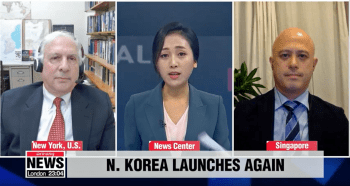
Arirang News has a new interview program at 8 am weekdays hosted by Oh Sooyoung called “Arirang News Global Insight.” Today, I was interviewed on North Korea’s second rocket test this year along with Dr. Graham Ong-Webb, Research Fellow, S. Rajaratnam School of International Studies, Nanyang Technological University in Singapore. We discussed what North Korea may be trying to achieve in the eyes of the world by continuing to conduct artillery strike drills involving multiple rocket launchers:

My comments on Joe Biden’s North Korea policy to Radio Free Asia

Joe+Biden+Finnegan+Biden+Vice+President+Joe+y-PGOrcIdmBl

I provided my comments today to Radio Free Asia’s Korean service on what likely would be leading Democratic presidential candidate Joe Biden’s policy toward North and South Korea:

Original Korean post:

“바이든, 실질적 합의 없인 대북관계 개선 않을 것”

English machine translation:

https://www.translatetheweb.com/?from=ab&to=en&a=https%3A%2F%2Fwww.rfa.org%2Fkorean%2Fin_focus%2Fnk_nuclear_talks%2Fbidennk-03052020154201.html

And here are my full comments as provided by email. Many thanks to Albert Hong:

“The Democratic Party has not had a good track record with North Korea since the Obama administration, unlike under the Clinton administration that negotiated the Agreed Framework in 1994. At best, under Obama, it had been one of benign neglect, and under President Trump, Democrats seem to have tried to sabotage his efforts in 2018-19 to engage North Korea. Nancy Pelosi apparently is extremely distrustful of North Korea (as she conveyed to the Speaker of the ROK National Assembly) and appeared to have deliberately scheduled Michael Cohen’s long-awaited House testimony while Trump was in Hanoi in late February 2019 while he was meeting Kim Jong Un – just to unnerve and distract Trump. In a sense, Pelosi helped contribute to the failure of the Hanoi summit.

“Unfortunately, I do not see a Biden administration changing the current policy of comprehensive sanctions and probably it would ramp joint military exercises back to normal (see Biden’s declared policy on North Korea here). If Trump had laid a foundation with Kim that led to an interim nuclear agreement, then if elected, Biden could build on that; but without any substantive agreement, Biden will likely not make any moves to improve relations with North Korea. However, Biden would not attempt to withdraw any U.S. troops from South Korea or demand excessive payment by the ROK to maintain American forces, whereas if reelected, Trump will likely draw down U.S. Forces Korea to about 4,000-5,000 and explain this drawdown is because the ROK refused to pay its fair share. This will have a very damaging impact to regional security in Northeast Asia.

“In contrast, Bernie Sanders has said he would be willing to meet with Kim Jong Un, but Sanders may no longer have a realistic path to the nomination given events in the last few days.”♦

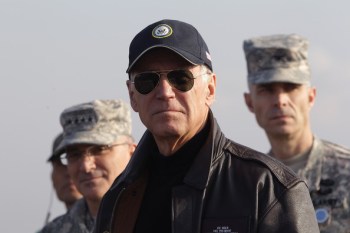
Photo at top: Vice President Joe Biden visited Observation Post Ouellette at the Demilitarized Zone (DMZ) on December 7, 2013 in Panmunjom, South Korea. 


Arirang News ‘Global Insight’ interview on North Korea’s first rocket test of 2020

ESJX8YOU4AA1WKC

Arirang News in Seoul has introduced a new interview program at 8 am weekdays hosted by Oh Sooyoung called “Arirang News Global Insight.” Today I was interviewed on North Korea’s first rocket test for 2020 along with Dr. Ramon Pacheco-Pardo of King’s College, London. It became a wide-ranging discussion, including on how the DPRK may factor into the U.S. presidential election:

Also, a segment based on the above interview was broadcast later in the day: